

Public Safety in Minneapolis
Public Safety in Minneapolis: Reimagining Public Safety
The League of Women Voters of Minneapolis has studied public safety, developed positions for action, and continues to monitor and participate in efforts to improve public safety across the city.
Our goal is to educate voters and drive meaningful change. We believe it is essential for all residents to be informed and to hold public officials accountable in order to achieve the level of public safety that Minneapolis communities deserve.
Our Approach to Public Safety
The League’s work on public safety is grounded in research, community input, and a commitment to nonpartisan education.
Through our Reimagining Public Safety initiative, we:
Study the history and current state of policing and public safety systems
Provide accessible, nonpartisan educational resources
Monitor city, state, and federal reform efforts
Encourage civic participation and accountability
This work reflects the League’s broader mission to increase public understanding of major issues and encourage informed participation in government.
Understanding Public Safety Reform in Minneapolis
Public safety reform efforts in Minneapolis have evolved significantly in recent years, shaped by community advocacy, policy changes, and ongoing evaluation.
Key developments include:
Creation of the Office of Community Safety in 2022 to integrate public safety functions into a more coordinated system
Movement toward a public health approach that focuses on prevention, response, and long-term community well-being
Expanded use of non-police responses for issues such as mental health crises and community support needs
Research and investigations at the state and federal level have also identified systemic challenges within policing, reinforcing the need for structural reform and continued oversight.
Policy Changes + Progress
Following 2020, Minneapolis and Minnesota implemented a range of policy and legislative changes aimed at improving accountability and public safety outcomes.
These include:
Bans on chokeholds and certain restraint techniques
Requirements for de-escalation and duty-to-intervene policies
Restrictions on no-knock warrants and certain traffic stops
Expanded training requirements related to bias, mental health, and community engagement
Creation of oversight mechanisms and reporting requirements for police conduct
Additional state-level reforms include measures related to firearm safety, bias-motivated crimes, and protections for reporting misconduct.
While progress has been made, continued implementation, training, and cultural change remain critical to achieving long-term impact.

Photo credit MinnPost.

League Positions on Public Safety
The League of Women Voters of Minneapolis supports a comprehensive and equitable approach to public safety.
Key principles include:
Fair and adequate law enforcement for all people
Equal justice regardless of race or socioeconomic status
A public safety system that includes both sworn officers and trained social service professionals
Emphasis on de-escalation, mediation, and community-based solutions
Transparent accountability systems and accessible complaint processes
The League also supports reforms to police discipline processes, expanded mental health response models, and policies that strengthen community trust and safety.
Public Safety Presentations
The League offers accessible educational materials to help the public better understand public safety issues. Watch the presentation from October 7, 2025. This 35-minute overview presentation covers:
The history of public safety in Minneapolis
Key reform efforts and policy changes
Progress to date and remaining challenges
Opportunities for civic engagement
You can also request a live, updated version of this presentation for your community group, neighborhood association, or organization by contacting: vote@lwvmpls.org
Read the Public Safety Summary Paper
The League provides an easy-to-read, 8-page summary, ‘Public Safety 2025: Beginning Steps on the Road to Reform’ that outlines:
Key public safety challenges
Work currently underway
Recommended next steps for reform
Access the summary: Download PDF
This resource is designed to help residents quickly understand complex public safety issues and ongoing efforts in Minneapolis.
Meetings, Forums, and Ongoing Discussion
The League hosts and shares forums that explore public safety issues in depth, including:
Reimagining Public Safety: Progress to Date and the Road Ahead
Civic Buzz forums on public safety beyond armed policing
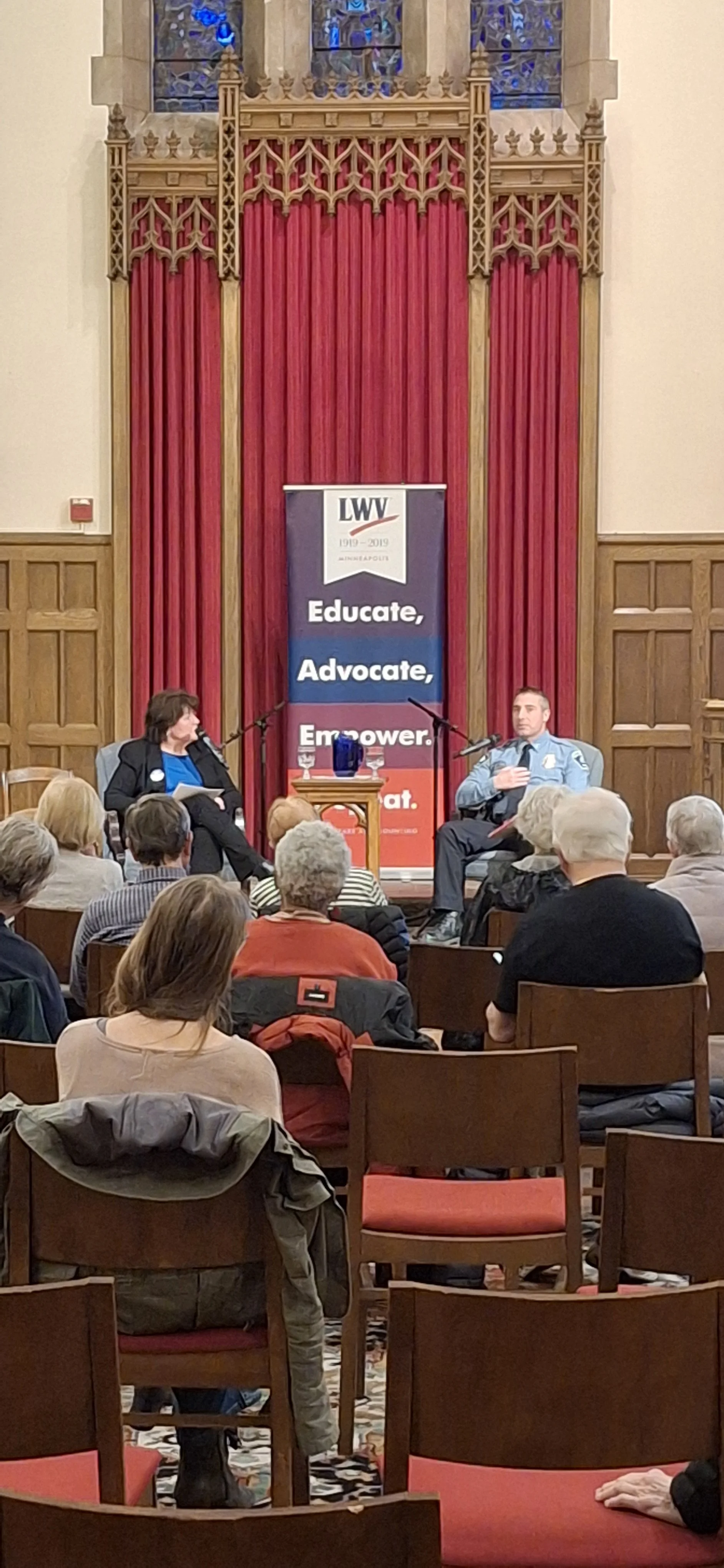
Discussions with local leaders such as the Commissioner of Community Safety and Minneapolis Police Chief
These events help foster informed dialogue and community engagement.
Who Impacts Public Safety in Minneapolis?
-
The mayor is the head of the executive branch of city government and is the chief executive officer supervising all the operational departments - including the police department.
The mayor appoints and supervises the chief of police and, except for budget, has “complete power” over the establishment, maintenance and command of the Minneapolis Police Department (“MPD”). The mayor makes all rules, regulations and special orders necessary to its operation. The mayor nominates and the city council appoints the police chief for a three year term. The chief “under the direction of the mayor” commands the MPD and reports to the mayor any “negligence or refusal” by police officers to discharge their duties. The reporting will change if the mayor’s proposal to formalize the Office of Community Safety is enacted by the city council. See question on the proposed new department.
The mayor proposes the city budget and appoints department heads who must be ratified by the city council. The city council funds the budget (including funding for the police). The mayor directs the collective bargaining of the city’s labor contract with the Minneapolis Police Federation.
-
The Minneapolis City Council is the legislative body that adopts local laws, makes policy, and oversees programs within the city government. The city council also has audit responsibility and authority to hold the executive branch accountable to the laws and programs enacted by the council. It is comprised of 13 members who are elected every four years by the voters of Minneapolis. Each council member is elected from and represents the interests of their ward.
The city council determines the design of the City’s administration by ordinance, which the Mayor can approve or veto. For public safety this is important because the mayor is proposing the creation of a new Department of Community Safety and restructuring all the public safety related departments into this new organization. The council is also responsible for approving the budget for the police, the new Office of Community Safety, the Department of Neighborhood Safety (formerly Violence Prevention plus some new functions), and all other operational departments.
-
The Office of Community Safety is a response to two issues on the Nov 2021 ballot: a call for a clearer and more accountable government structure and changes to improve our public safety.
The city council approved the creation of a new role, the Commissioner of Public Safety, and Cedric Alexander was approved to fill that role in August 2022. He is the first Minneapolis Commissioner of Community Safety; he reports directly to the Mayor.
The mayor has proposed a structure that integrates and unifies the public safety functions. It would include Police, Fire, 911(MECC), Emergency Management and the new Neighborhood Safety Department (which includes the Office of Violence Prevention and the Behavior Crisis Response Teams). The city council is responsible for the defining and passing the ordinances that would make this office operational. This work is in process. For more information see FAQ on new department.
-
The Department of Neighborhood Safety, formerly the Office of Violence Prevention and expanded with Behavioral Crisis Response, has been elevated to a new standalone department within the proposed Office of Community Safety. Its 2023 budget of $8.015 million will use some ARPA federal funds. Its budget in 2024 of $8.075 million transitions to general funds. With increased funding it will be able to expand programming to support outreach and neighborhood-based partnerships. The Department of Neighborhood Safety uses a community-focused, data supported, public health approach to breaking the cycle of violence.
-
The Minneapolis Department of Civil Rights (MDCR) is a city department charged with enforcing the city’s code of ordinances, including those relating to non-discrimination and police conduct oversight. Within the department is the Police Oversight Commission, made up of volunteers who are Minneapolis residents, and the Office of Police Conduct Review (OPCR). The Police Oversight Commission is charged with conducting audits and studies based on MPD data and making recommendations on MPD policies and procedures. The OPCR is a neutral agency that investigates allegations of police misconduct made by citizens to the City. It also maintains a dashboard/data portal that contains up-to-date statistics regarding MPD complaints, open cases and investigations, demographics, officer discipline and review panel recommendations. For more information, see FAQ on Transparency and Accountability.
-
In 2012, 30 years after the first civilian oversight body was created, a new civilian oversight entity was created, comprising three separate bodies.
The Office of Police Conduct Review (OPCR) consists of a civilian unit under the authority of the director of Minneapolis Department of Civil Rights and an Internal Affairs Unit (IAU) under the authority of the MPD. It was charged with receiving, reviewing and investigating complaints of alleged police misconduct. Summaries of their cases are available on the city’s website.
The Police Conduct Review Panel (PCRP) consists of civilian appointees and MPD supervisors. The Panel reviews the OPCR investigation reports and passes them and its recommendations along to the chief of police.
The Police Conduct Oversight Commission (PCOC), an independent panel of nine residents, appointed by the mayor and the city council, charged with ensuring the City delivers police services in a lawful and non-discriminatory manner by engaging the community, reviewing policy, auditing cases, and other duties.
These agencies continue to be thwarted in their efforts to reform police policies and officer conduct. For more information, see FAQ on Transparency and Accountability.
-
The Police Officers Federation of Minneapolis (the “Federation”) represents police officers up to the rank of lieutenant who are employed by the City of Minneapolis and the Minneapolis Park and Recreation Board. The Federation, with over 800 members, is the largest non-affiliated law enforcement union in Minnesota. It represents officers in matters relating to their working conditions (e.g. wages, health insurance, discipline), including negotiating and enforcing the labor contract, lobbying to advance their interests, and representing individual officers during investigations and disciplinary hearings. It is led by President Sheral Schmidt.
-
The Minnesota Department of Human Rights is the state’s civil rights enforcement agency protecting those rights through the Minnesota Human Rights Act. The agency’s primary duties are to: investigate charges of discrimination, oversee equity and inclusion for state contracting, and educate to reduce discrimination and disparate outcomes.
Following the murder of George Floyd the Minnesota Department of Human Rights undertook a two year investigation into the violence and race-based practices of the city of Minneapolis and the Minneapolis Police Department (MPD) and released a report in April 2022.
-
In Minneapolis there are over 1,000 911 calls per day. 911 operations are managed by the Minneapolis Emergency Communications Center (MECC) which is its own department, under the city coordinator, but is proposed to be part of the new Office of Community Safety, if enacted. MECC is also a part of the Hennepin County 911 system governed by the state of Minnesota and state statute. MECC is further governed by a regional agency, the Metropolitan Services Board. There are: MECC, Hennepin County Sheriff, Bloomington, Eden Prairie, Edina, St. Louis Park, Minneapolis St. Paul Airport, and the University of Minnesota.
MECC handles all 911 calls (Police, Fire, and EMS) for the city proper and does its own hiring and training. For medical calls, they take the initial information and then the call is given to either Hennepin Healthcare or North Memorial for ambulance service. Police and fire calls are handed off to the appropriate agencies. Much is happening to reform 911 responses, especially with regard to mental health calls.
-
Hennepin County has social service programs that serve Minneapolis and city residents receive most of their mental health services through the county. Within its programming is a comprehensive plan addressing mental health needs of individuals in the criminal justice system. In November 2020, the county detailed those efforts. Two of the programs that the County sponsors are described below.
-
Community Outreach for Psychiatric Emergencies (COPE) is a mobile mental health crisis intervention program. The state mandates mental health crisis services in all counties in Minnesota via the Minnesota Department of Human Services. In Minneapolis, Hennepin County COPE provides 24-7-365 crisis services and a call center to adults experiencing a psychiatric emergency. In addition t)o telephone assessment and in-home or face-to-face crisis response, COPE can arrange for continued mental health support for individuals for up to 30 days and make referrals to residential care.
-
When Police find someone in crisis, they can use the facility at 1800 Chicago as a resource. 1800 is an “Urgicare” as opposed to an emergency room. An individual arriving at 1800 needs no appointment to have a medical and social service evaluation. The individual in crisis can stay for up to 10 days and detox, and if needed for a longer period up to 6 months, connecting them to medical, behavioral, food and employment resources. There are 64 beds for withdrawal and
16 mental health beds (although Covid has created some capacity issues).
The County drew on national models of early diversion facilities as they transformed a county-owned three-story, nearly 103,000-square-foot building into the 1800 Chicago Avenue facility, just south of downtown Minneapolis. In 2018, the county added a 16-bed mental health stabilization program and contracted its operation to a community-based agency.
This program served close to 1,000 people in 2019. Participants experienced:
85% reduction in crisis symptoms and improvement in psychiatric stability
93% discharge to the least restrictive living environment after treatment
-
Hennepin EMS is an urban/suburban 911 EMS agency that handles more than 87,000 calls for service each year from the residents and visitors of Hennepin County, Minnesota. Hennepin EMS is based at Hennepin Healthcare in downtown Minneapolis and serves 14 municipalities, covering 266 square miles, and a resident/visitor population of nearly 1.5 million.
-
The Minnesota Department of Public Safety (DPS), created in 1969, is an enforcement, licensing and services agency, operating programs in law enforcement, traffic safety, alcohol and gambling, fire safety, driver licensing, vehicle registration and emergency management. The State Patrol, Bureau of Criminal Apprehension (BCA), and the Alcohol and Gambling Enforcement Division are part of this agency led by the Commissioner of Public Safety, John Harrington, who was appointed by the Governor. In May 2022, it entered into a Joint Powers Agreement with the City of Minneapolis to assist the MPD with law enforcement and criminal investigations, including for gun crimes, shootings and carjackings.
At the request of the MPD or other local law enforcement, the BCA investigates officer-involved shootings. This includes: use of deadly force or when an officer intentionally uses force that leads to serious injury or death. The BCA has investigated a number of shootings in Minneapolis and other agencies.
-
The Minnesota Peace Officer Training Board, or POST Board, establishes law enforcement licensing and training requirements and sets standards for law enforcement agencies and officers throughout the state.
Among its duties, the board licenses peace officers and part-time peace officers; administers license examinations; establishes minimum qualifications and standards of conduct and monitors compliance with them; regulates professional peace officer education and continuing education for peace officers; establishes and maintains pre-service education curriculum.
Per MN Statute 626.841, the POST Board is composed of the following 17 members, with most appointed by the governor:
2 sheriffs
4 municipal police officers, including at least two chiefs of police
2 peace officers, one who is a member of the Minnesota State Patrol Association
1 superintendent of the Minnesota Bureau of Criminal Apprehension or a designee
2 peace officers or former peace officers currently employed in a professional peace officer education program
1 administrator from Minnesota colleges or universities that offer professional peace officer education
1 elected city official from a city outside the metropolitan area with a population under 5,000
4 members of the general public
The governor appoints a chair with a goal (by statute) of achieving representation from among the geographic areas of the state. Kelly McCarthy, Chief of Police in Mendota Heights, is the current Chair of the POST Board.
The POST Board Citizen Advisory Body
The 2020 2nd Special Session added MN Statute 626.8435, which established a citizen advisory body to the POST Board called the Ensuring Police Excellence and Improving
Community Relations Advisory Council. By statute, the 15 member Advisory Council consists of:
Superintendent of the Bureau of Criminal Apprehension (or designee)
Executive Director of the POST Board
Executive Director of the Minnesota Police and Peace officers Assoc.
Executive Director of the Minnesota Sheriff's Assoc.
Executive Director of the Minnesota Chiefs of Police Assoc.
6 community members:
4 representing community-specific boards under MN Statutes sections 15.0145 and 3.922 (Council on Latino Affairs, Council for Minnesotans of African Heritage, Council on Asian-Pacific Minnesotans, Indian Affairs Council)
1 advocate for victims appointed by Violence Free Minnesota
1 mental health advocate appointed by Minnesota Chapter of the National Alliance on Mental illness
4 members appointed by the legislature
-
Several entities within state government impact public safety, including but not limited to:
Minnesota Governor
The state’s Governor is the chief executive for the state. In this office, the Governor appoints and oversees the Commissioners of the Department of Public Safety and the Department of Human Rights; serves as the commander-in-chief of the Minnesota National Guard; and recommends funding for public safety initiatives in the annual budget. Attorney General
The Attorney General is the chief law officer for the state, and as such represents the state in both state and federal courts and administrative proceedings and rulemaking. The Attorney General handles felony criminal appeals, advises local prosecutors in the conduct of criminal trials and handles cases at the request of local prosecutors .
State Legislature
The Minnesota legislature, consisting of two houses (the Senate and the House of Representatives) are elected by the citizens. Both houses meet annually between January and the end of May to enact legislation on various issues, including public safety. Due to partisan differences, in 2022 the legislature passed no significant criminal justice bills.
-
In general, police powers and control generally belong to the state (who delegates those to counties and cities). At least one federal law, however, exists outside this scheme and has a huge impact on that state power: Qualified Immunity.
Qualified Immunity
Qualified Immunity protects public employees from being sued individually for actions they undertake on the job, unless that public employee violates “clearly established” statutory or constitutional rights. See Qualified Immunity | Wex | US Law | LII / Legal Information Institute, Cornell Law School, June 3, 2020 and Qualified Immunity: Both Sides of the Debate Findlaw, September 21, 2021.
Since 2009, courts have dismissed more than half of cases brought against individual police officers based on qualified immunity. See Shielded | For cops who kill, special Supreme Court protection, Reuters, June 1, 2020.
Qualified Immunity was created and must be changed at the federal level. To do this, either courts need to reinterpret it, with the Supreme Court affirming, or the U.S. Congress needs to transform it through legislation passed by both bodies and signed by the sitting president.
The proposed state legislation, H.R.1280 - George Floyd Justice in Policing Act of 2021 which called for limited qualified immunity passed the House, did not pass in the Senate.
Department of Justice (DOJ)
The United States Department of Justice, also known as the Justice Department, is a federal executive department of the United States government tasked with the enforcement of federal law and administration of justice in the United States.
Join the League of Women Voters of Minneapolis
Support nonpartisan education and advocacy on public safety and other critical issues in Minneapolis.
As a member, you can:
Help expand access to trusted information
Participate in research, discussion, and advocacy efforts
Stay informed on evolving public safety policies
Contribute to a more informed and engaged community
Join today and be part of the work to strengthen public safety and democracy in Minneapolis.
Common Questions
-
The League studies public safety issues, educates voters, develops positions for action, and advocates for policies that support equitable and effective public safety systems.
-
It refers to exploring new approaches to safety that include prevention, community-based solutions, and coordination between law enforcement and social services.
-
Recent changes include new laws, policy reforms, expanded oversight, and the creation of the Office of Community Safety to coordinate services.
-
The League provides presentations, summary papers, and curated reports that explain the history, current efforts, and future directions of public safety reform.
-
You can attend forums, review educational materials, engage with local government, and join the League to participate in ongoing work.
-
No. The League is nonpartisan and does not support or oppose political parties or candidates. It focuses on education, research, and advocacy based on consensus positions.